 |
|



 |
|
 |



| SSP Features |
Architecture Features Interfaces |
Below is a very brief list of major SSP features. SSP documentation, which is availble
upon request, provides a more detailed view. SSP fully implements requirements of VXML 2.1 and implements almost all optional features of it. SSP is available on Linux and MS Windows. It is currently using SIP or Intel/Dialogic hardware platforms. Its design allows to quickly integrate SSP with other telephony platforms. Ssp comes with integrated monitoring subsystem, which provides a view of ssp components and their status along with call statistics. SSP provides full implementation of the VXML object functionality, which includes using media operations inside objects. SSP allows for large number of customization plugins to customize it for use with different MRCP servers, encoders and custom log listeners. SSP provides an open interface that allows for development of custom applications that do not use VXML, but are still able to take advantage of SIP/MRCP and the robust service grid environment of the SSP framework. Writing an SSP service is implementing a shared library with 2 functions which can be done in a matter of hours. SSP is designed to be easily integrated into an existing environment. SSP provide a capability to record calls and conferences. Various recording modes can be specified in the configuration files or using VXML properties at run time. SSP also provides conferencing capability. This includes conferences with full and half duplex mode. It includes multiparty conferences with the number of participants limited only by the CPU power or “intelligent” transfers when a VXML session is kept around while the transferred conversation takes place to be resumed when it terminates. The following graphic demonstrates relationships between SSP components and the outside world. 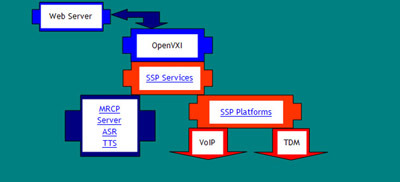
|
 |
| Copyright © 1996-2013 IEC, Inc. All Rights Reserved. |
 |